
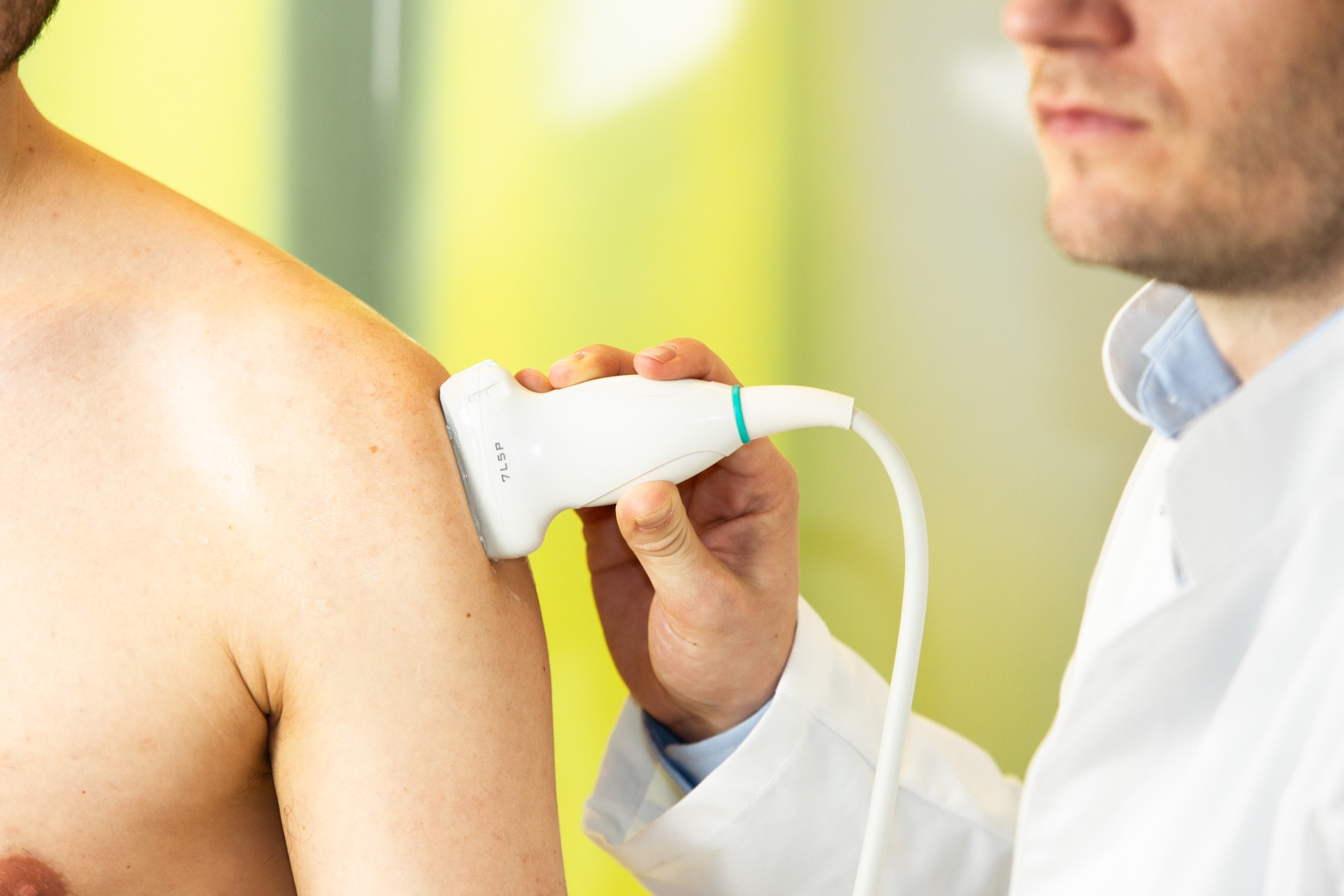
PRP and ACP are autologous blood products used in orthopedics for conditions including knee osteoarthritis and selected tendon and joint problems. The key question is not whether treatment with a person’s own blood works in general, but which preparation is appropriate for which diagnosis. PRP is not a uniform substance: platelet concentration, white and red blood cell content, volume, activation and injection protocols can vary considerably. Research findings and recommendations vary accordingly.
What is PRP?
PRP stands for platelet-rich plasma. After a blood sample is taken and centrifuged, a plasma fraction with a higher platelet concentration than the original blood is obtained. Platelets release numerous growth factors and signaling substances that can influence inflammation and healing. This biological rationale matters, but it does not automatically demonstrate structural regeneration of cartilage or tendons.
Commercial systems differ considerably. Reviews report platelet concentrations ranging from approximately 1.6 to 18 times the baseline concentration, depending on the system; white and red blood cell content also varies substantially. Asking whether PRP is good is therefore too broad a medical question. A better question is: which PRP preparation has been studied for this diagnosis, and with which protocol?
What is ACP?
ACP stands for autologous conditioned plasma and refers to a commercially prepared, typically leukocyte-poor PRP product. ACP is therefore not a completely different active substance, but a particular form or preparation system for an autologous blood product. The name alone does not establish general superiority over other PRP systems.
Why does the composition matter?
- Platelet concentration and total platelet count
- White blood cell content: leukocyte-poor or leukocyte-rich
- Red blood cell content
- Whether the preparation is activated
- Final preparation volume and injection volume
- A single injection versus a series of injections
- The interval between sessions
- Image-guided injection technique
- Accompanying treatment and the rehabilitation protocol
How strong is the overall evidence?
The evidence depends on the indication. For knee osteoarthritis, numerous randomized trials, meta-analyses, consensus papers and recent guidance statements are now available. However, preparations and protocols remain heterogeneous. For many muscle, ligament and tendon injuries, the evidence is substantially weaker or inconsistent. PRP should therefore not be offered indiscriminately as a regenerative treatment for everything.
The AAPM&R guidance on PRP for knee osteoarthritis published in 2026 summarizes the evidence and sets out five recommendations and eleven consensus-based best-practice points. It supports selective use for knee osteoarthritis, while explicitly emphasizing the need for robust, dose-dependent randomized trials and the importance of individual clinical judgment.
PRP and ACP for knee osteoarthritis
In selected patients with mild to moderate knee osteoarthritis, PRP may improve pain and function for several months. Some meta-analyses of randomized trials show advantages over hyaluronic acid or other injections. However, results depend on the preparation, control group, stage of osteoarthritis and follow-up. At the same time, the large RESTORE trial found no convincing advantage over placebo at twelve months for pain or medial tibial cartilage volume. This argues against simplistic promises of a cure, not against every use for symptom management.
Positive clinical data are available for ACP, including larger case series and studies of leukocyte-poor preparations. Here too, the chance of a clinically meaningful improvement is not 100%, and the absence of a control group can lead to an overestimate of the specific treatment effect.
PRP for patellar tendon pain
A progressive loading program is the central treatment for patellar tendinopathy. Modern rehabilitation combines load management, progressive strength development, energy-storage loading and sport-specific progression. Meta-analyses do not show consistent superiority of PRP over other injections or saline. An injection may be discussed in an individual case, but it should not replace a structured tendon rehabilitation program.
PRP for Achilles tendinopathy
The evidence is less supportive for chronic Achilles tendinopathy. Randomized trials and meta-analyses show no reliable advantage over placebo for pain or function. Progressive calf and tendon loading, management of running and jumping loads, and a staged return to sport remain the foundation of treatment.
PRP for rotator cuff and shoulder conditions
Studies of rotator cuff conditions sometimes show short-term improvements. As a biological adjunct to surgical rotator cuff repair, there is evidence of lower retear rates in certain circumstances, but this does not establish a general clinical benefit for every patient. In a randomized trial of shoulder osteoarthritis, leukocyte-poor PRP and hyaluronic acid did not differ significantly at twelve months; both groups improved.
PRP for muscle and ligament injuries
PRP has not reliably shortened the time to return to sport after acute muscle injuries. After ACL reconstruction, robust evidence of a lasting benefit for stability and return to sport is also lacking. Rehabilitation, neuromuscular control, progressive loading and objective functional criteria remain decisive in these areas.
PRP for cartilage injuries and the ankle
Some small studies of focal cartilage defects and osteochondral lesions of the talus have reported positive findings, but the evidence is considerably more limited than for knee osteoarthritis. An injection cannot correct a mechanical defect, malalignment or instability. Before a biological adjunct is considered, it is therefore important to establish whether the problem is a focal defect, diffuse osteoarthritis or an accompanying mechanical cause.
Safety and side effects
Because PRP and ACP are obtained from the patient’s own blood, systemic allergic reactions are rare. Temporary pain, swelling, tenderness or a short-term reduction in load tolerance are more common. Local irritation may initially increase after a tendon injection. Regardless of the preparation, the usual risks of an injection remain, particularly infection and bleeding.
What should be documented before treatment?
- The confirmed diagnosis and target structure
- The PRP system and preparation method
- Platelet and white blood cell characteristics and, where possible, red blood cell characteristics
- Final volume and number of injections
- Intervals between sessions
- Whether the injection is image-guided or guided by anatomical landmarks
- The rehabilitation plan
- Specific criteria for success within a defined assessment period
How much does PRP or ACP cost in Munich?
Costs depend on the preparation system, number of injections, imaging, extent of assessment and follow-up. A transparent estimate should itemize the consultation, blood collection, preparation, injection and planned follow-up appointments. A higher price or more elaborate preparation does not itself demonstrate greater effectiveness.
When is a second opinion useful before PRP or ACP?
A second assessment is particularly useful if PRP is advertised as guaranteed cartilage regeneration, several injections are planned without a specific diagnosis or success criteria, a standard rehabilitation program has not yet been adequately completed, or surgery is also being recommended. It can also help if it is unclear which preparation will be used.
A clinical perspective
The most important quality distinction in PRP treatment is not the label describing treatment with a patient’s own blood, but the indication. A sound treatment plan answers three questions in advance: which structure is actually painful? Which PRP protocol is plausible for this particular indication? And how will success be assessed through function, load tolerance and clinical progress, independently of the injection itself?
Conclusion
PRP and ACP are not one uniform treatment, but a group of autologous blood products with different compositions and protocols. The strongest evidence concerns selected patients with mild to moderate knee osteoarthritis. Evidence for tendon, muscle and ligament injuries is much less consistent. Responsible use therefore combines a precise diagnosis, transparency about the preparation, realistic goals and structured rehabilitation.
Scientific references
- Collins T, Alexander DP, Barkatali B. Platelet-rich plasma: a narrative review. EFORT Open Rev. 2021;6:225–235. DOI: 10.1302/2058-5241.6.200017.
- Tischer T et al. PRP as therapy for cartilage, tendon and muscle damage – German working group position statement. J Exp Orthop. 2020;7. DOI: 10.1186/s40634-020-00282-2.
- Korpershoek J et al. Effect of Autologous Conditioned Plasma Injections in Patients With Knee Osteoarthritis. OJSM. 2023;11. DOI: 10.1177/23259671231184848.
- Filardo G et al. PRP Injections for the Treatment of Knee Osteoarthritis: Meta-Analysis of RCTs. Cartilage. 2020. DOI: 10.1177/1947603520931170.
- Bennell K et al. RESTORE Randomized Clinical Trial. JAMA. 2021;326:2021–2030. DOI: 10.1001/jama.2021.19415.
- Borg-Stein J et al. AAPM&R guidance statement on platelet rich plasma for knee osteoarthritis. PM&R. 2026;18 Suppl 2:S20–S35. DOI: 10.1002/pmrj.70144.
- Ophey M et al. Dutch multidisciplinary guideline on anterior knee pain: patellofemoral pain and patellar tendinopathy. KSSTA. 2024;33:457–469. DOI: 10.1002/ksa.12367.
- Barreto ESR et al. Is Platelet-rich Plasma Effective in Treating Achilles Tendinopathy? CORR. 2024/2025. DOI: 10.1097/CORR.0000000000003349.
- Chen XT et al. Use of PRP for pain and function in rotator cuff tears. AJSM. 2020;48:2028–2041. DOI: 10.1177/0363546519881423.
- Kirschner J et al. Leukocyte-poor PRP versus hyaluronic acid in glenohumeral osteoarthritis. Clin J Sport Med. 2022;32:558–566. DOI: 10.1097/JSM.0000000000001029.
- Lim JJ et al. Majority of Orthopaedic PRP Investigations Don’t Report Protocols and Composition. Arthroscopy. 2024. DOI: 10.1016/j.arthro.2024.03.021.